
Experience Bible history at the life-size Noah’s Ark! Meet Noah, his family, and the animals on the Ark. The family-friendly Ark Encounter theme park.
-online ad for Ark Encounter
As a child, my parents and grandparents taught me to believe in God. On my father’s side, my grandparents, Bert and Jessella, were “true believers.” On my mother’s side, her father, Harold, much less so. My father, as the patriarch, dominated the family and so my brother and I were coerced into going to church up to the ages of 14 or 15. The Bible was the prevailing gospel in our family. In college, this practice ended and both my brother and I began our journey into agnosticism and atheism, until I found a spiritual practice late in life a great distance from my Protestant upbringing.
When I visited the Ark recently in Williamstown, Kentucky, I felt myself the only skeptic in a crowd of believers. Yet, surprisingly, the story of Noah and the people around me did not feel foreign. It felt surprisingly familiar. An exorbitant investment in large scale entertainment cloaked as a religious mecca. A gross merger of religion, entertainment and capitalism. Quite frankly, it’s a destination paid for partially by a $62M bond to promote the economic benefits of tourism. I realized outside the 51’ high and 510’ long structure that the “Ark Encounter” represented, not just a culmination of human ingenuity but of credulity.
Why would hundreds of thousands of pilgrims pay millions of dollars in parking, hotels, restaurants, entrance fees and merchandise to visit an 800-acre site (two farms) to walk 10,000 steps and several thousand feet of ramps, gawking at beautifully executed dioramas, props, graphics and masterful woodworking skills of the Amish? The magnificence of the structure, although impressive, does not do it alone. I’m convinced that it’s the underlying fanaticism of the faith that propelled people to build it and propels people to visit it. And where else but in an impoverished, rural area of central Kentucky.
So let me try and put a spin on the story of Noah as written in the book of Genesis. Let’s start with the story as I learned it: The world was created in 7 days. In the course of time, humans (having been granted free will) deviated from God’s plan and corruption followed. As the Bible tells it, God looks unfavorable upon the mess and directs Noah to assist in the reset. God creates the Flood in the aftermath and Noah is challenged to build the boat to save the followers of God that inhabit the terrestrial earth. Does not the flood represent a myth of ending evil and restoring goodness on earth: a mass genocide?
I don’t know about the thousands of people in attendance at the Ark Encounter, but I had great difficulty with the explanation of the animals 2 x 2 (or 7×7) boarding an ark (which includes dinosaurs) and then procreating like mad when the water recedes. Is the flood a parable that affects just a small part of the earth, or did it cover the earth? According to the Ark Encounter and the Bible, it was a global flood. This makes the story of the ark more dramatic, yet less believable.
While the Ark Encounter is set in the distant past, I sensed the genesis of something bigger in present day: the cruise industry. While Royal Caribbean could build fanciful cities on the sea, this replica of a ship seemed permanently staged on massive concrete footings buttressed by hundred-year-old pine logs. Simply put, it is an enormous prop spanning nearly one and a half football fields designed to process thousands of people a day. From the parking lot to the entrance gate to the buses that transported you a mile to the scene of the ark, everything about the encounter is designed to move visitors through an experience that is “full scale evidence” of their religious beliefs. And entertain along the way to justify the hefty ticket prices. Including a virtual reality Pixar presentation theater, TRUTH TRAVELER, a petting zoo, a restaurant and a carousel.
Sidebar: throughout the encounter, the operations makes accessible at every turn the American Dream: shopping. On top of the cost of parking and entrance fees (up to three-day adventures), you can buy souvenirs of your Biblical Encounter of a Third Kind.
“Accuracy” seems to be an obsession within the Ark Encounter. Disclaimers abound reminding visitors that this ark is only a representation of the real ark. This replica is designed to accommodate thousands of people, not animals. But this intent becomes somewhat confusing with the presence of “infant” dinosaurs on board along with the kinds of other species. Near the end, countless artfully presented arguments abound overriding modern scientific “facts” that challenge the voracity of the story. And all of the biblical believers (who paid an entrance fee) move from panel to panel, reassured that their biblical beliefs are their salvation. Even human induced climate change is disavowed. Visitors can return home in the comfort of their carbon generating cars, to the protection of their carbon emitting homes, blissed out on their devices. And they can relive their Ark Encounter at their next family or church social with photographs of their visit.
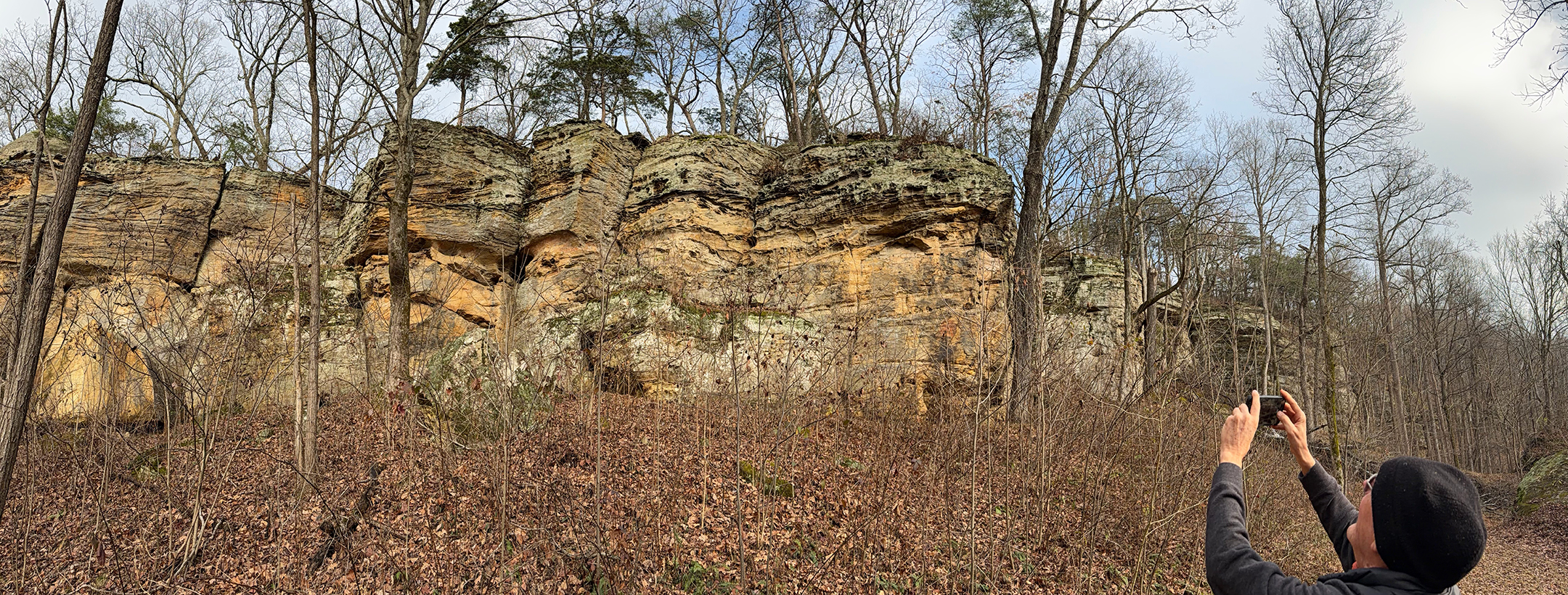
Three hours later, south of the Ark, I’m visiting Furnace Mountain: a Zen Buddhist retreat center. I’m an invited guest who comes to visit, continuing his journey in search of solace and meaning. It’s clear to me that the Ark Encounter did not fulfill this wish. I’m with my travel companion who lived for two years on the Mountain nearly 25 years ago. Nestled high on a mountain ridge, we arrived after a treacherous snake bit winding “Kentucky” backroad. The visit is comprised of “sitting” for 10 minutes in the zen temple, looking out over the distant blue ridge mountains. A walk along an enormous limestone rock outcropping carved by weather over millions of years. Unlike the Ark, it’s a nature made outcropping with magnificent imperfections and makes no pretense to be other than what it is. In this I find great solace. The background story is one of geological time, of a place where the ancestors lived with this land long before us. We concluded our visit at the Tea House with a bowl of carrot ginger soup. In my memory, the Ark, an entertainment venue perched deep in the hidden valley of Kentucky farmland, stands in contrast to the rock and temple high above in the mountains. One inviting thousands of paid guests, the other hosting a few with a calling.